Guide
Pour Over vs French Press: Which Makes Better Coffee?
By Home Coffee Spot Editorial Team · Updated 2026-03-22
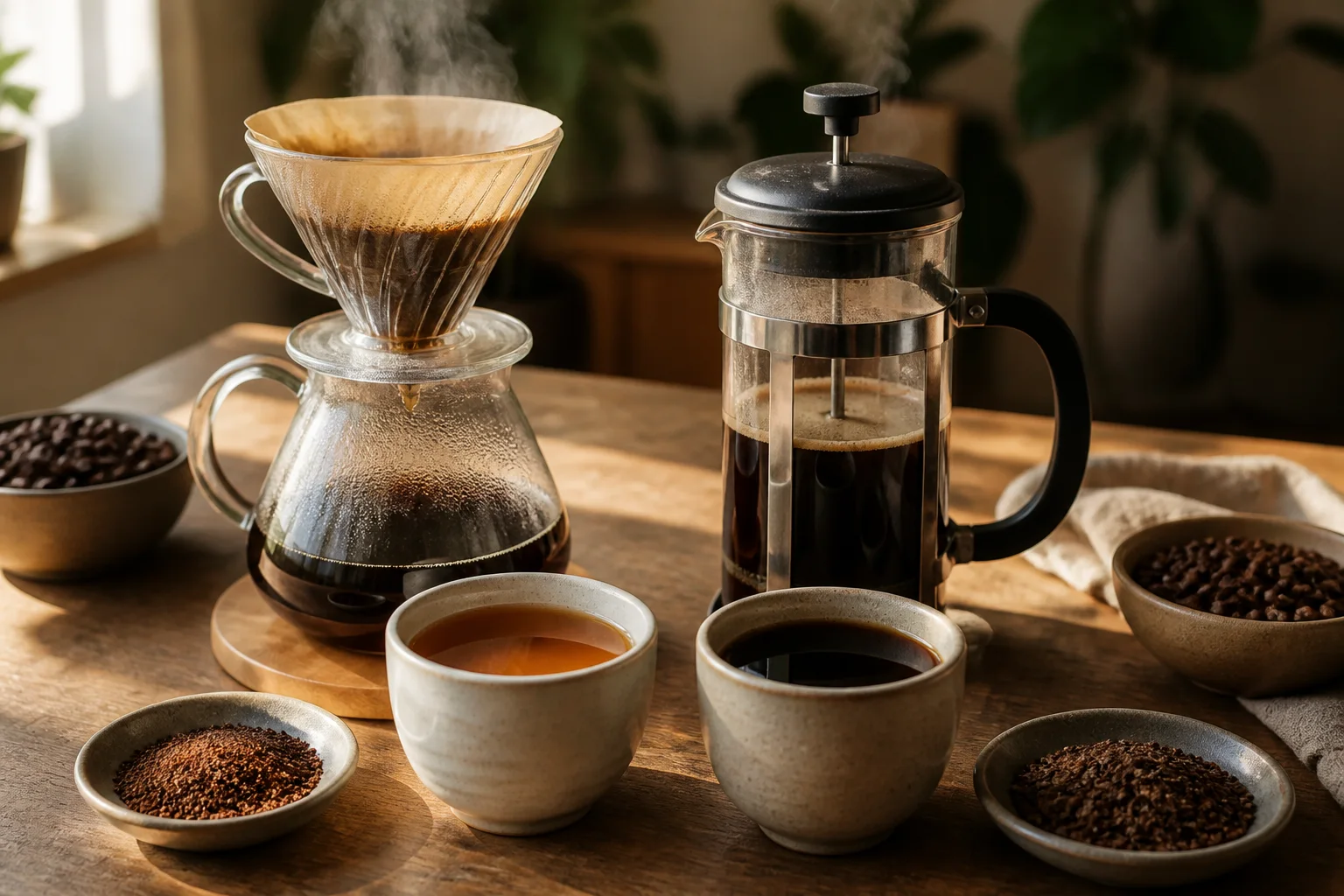
Pour over coffee uses a paper filter and slow, controlled pouring to produce a clean, bright cup that highlights delicate origin flavors, while French press uses a metal mesh plunger and full immersion steeping to deliver a rich, heavy-bodied brew with more oils and sediment. The best method depends on whether you prioritize clarity and nuance or body and boldness in your daily cup.
Affiliate disclosure: This article contains affiliate links. If you purchase through our links, we may earn a small commission at no extra cost to you. This helps support HomeCoffeeSpot and allows us to continue producing in-depth coffee guides.
 Hero visual for this section
Table of Contents
 Comparison visual for Table of Contents

- Taste and Flavor Profile Comparison
- Equipment You Need
- Best Pour Over and French Press Products
- Step-by-Step Brewing Guides
- Head-to-Head Comparison Table
- Which Method Is Right for You?
- Common Mistakes to Avoid
- FAQs
- Sources and Methodology
How Each Method Works
 Infographic visual for How Each Method Works
Understanding the mechanics behind each brewing method is essential for choosing the right one. Pour over and French press represent two fundamentally different extraction philosophies — percolation versus immersion — and that distinction shapes everything from grind size to final cup character.
Pour Over: The Percolation Method
Pour over brewing is a percolation method where hot water passes through a bed of ground coffee held in a paper or cloth filter, driven by gravity. You heat water to 200-205 degrees Fahrenheit, place a medium-fine grind in the filter, and pour in slow, concentric circles over a period of three to four minutes. The paper filter traps oils, fines, and sediment, producing a remarkably clean cup.
The key variable in pour over is flow control. How fast or slow you pour, where you direct the stream, and how you manage the bloom phase (the initial 30-45 second pour that releases CO2 from fresh grounds) all affect extraction. This level of control is what draws enthusiasts to the method — every pour is an opportunity to refine your technique and chase a better cup.

French Press: The Immersion Method
French press brewing is a full immersion method. You add coarsely ground coffee to the carafe, pour hot water over it, and let the grounds steep for four minutes. Then you press the metal mesh plunger down to separate the grounds from the liquid. Because the metal filter has larger openings than paper, oils and fine particles pass through into your cup, creating a heavier, more textured body.
The simplicity of French press is its greatest strength. There is no pouring technique to master, no filter to rinse, and no special kettle required. You measure, pour, wait, and press. The immersion method also means extraction is more forgiving — since all the grounds are in contact with all the water for the entire steep time, minor inconsistencies in grind size matter less than they do in pour over, where channeling can cause uneven extraction.
Taste and Flavor Profile Comparison
 Setup visual for Taste and Flavor Profile Comparison
This is where the two methods diverge most dramatically, and where your personal preference will ultimately decide the winner.
Pour Over Flavor Profile
Pour over coffee is defined by clarity. The paper filter removes nearly all of the coffee oils (specifically diterpenes like cafestol and kahweol) and the fine sediment particles that contribute to body and mouthfeel. What remains is a clean, transparent cup that lets you taste the individual flavor notes of the coffee with remarkable precision.
A well-brewed pour over of a washed Ethiopian Yirgacheffe, for example, will present distinct notes of jasmine, bergamot, and stone fruit with a tea-like body and a crisp, lingering finish. Those same beans brewed in a French press would taste heavier, rounder, and less distinctly floral. Neither is wrong — they are simply different expressions of the same coffee.
Pour over also tends to produce higher perceived acidity (brightness), which some drinkers love and others find off-putting. If you enjoy the sparkling, citrusy quality of light-roast specialty coffee, pour over is almost certainly your method.

French Press Flavor Profile
French press coffee is all about body. The metal mesh filter allows coffee oils to pass into your cup, coating your palate with a rich, almost velvety texture that paper-filtered methods strip away. You also get micro-fines — tiny coffee particles that are too small for the mesh to catch — which add a subtle grittiness and contribute to a fuller, more robust mouthfeel.
The flavor profile of French press coffee skews toward chocolate, nuts, caramel, and deeper fruit notes. It rounds off the sharp edges of acidity and amplifies sweetness and body. For medium and dark roasts, French press is often the preferred method because it complements and enhances the roast-forward flavors rather than highlighting the bright, delicate origin notes that lighter roasts are known for.
One important consideration: the oils that give French press its characteristic body are the same diterpenes (cafestol and kahweol) that studies have linked to modest increases in LDL cholesterol when consumed in large quantities. For most people drinking two to three cups daily, this is a negligible concern, but it is worth knowing if you have existing cholesterol issues. Pour over's paper filter removes roughly 95 percent of these compounds.
Equipment You Need
 Detail visual for Equipment You Need
Pour Over Equipment
A basic pour over setup requires a dripper, paper filters, a gooseneck kettle for precise pouring, a scale, and a burr grinder. The total startup cost ranges from about $60 for a bare-bones setup (plastic V60, basic kettle, manual grinder) to $250 or more for a premium kit (ceramic dripper, Fellow Stagg kettle, electric burr grinder).
The gooseneck kettle is not optional. A standard kettle pours too fast and too imprecisely for good pour over technique. You need the slow, controlled stream that a gooseneck spout provides. If you do not already own one, budget $35-80 for an electric gooseneck kettle or $25-40 for a stovetop model.
French Press Equipment
A French press setup is simpler and cheaper. You need the press itself, a kettle (any type works), a scale, and a grinder. Total startup cost ranges from $25 for a basic Bodum press and hand grinder to $120 for a premium press with an electric grinder. No special kettle is required — any vessel that pours hot water will do.
The lower equipment bar is one of French press's strongest advantages for beginners. You can be making excellent coffee with minimal investment and virtually no learning curve.
For a deeper dive into grinder selection, see our best coffee grinder for home guide. And if you are already sold on pour over, our complete pour over coffee guide walks you through advanced technique and equipment recommendations.
Best Pour Over and French Press Products
 Lifestyle visual for Best Pour Over and French Press Products
Here are five products that cover both methods, selected based on build quality, brew performance, and value. Each one has been tested by our team over multiple weeks of daily use.
Hario V60 Ceramic Dripper
Best Overall Pour Over Dripper

- Ceramic construction retains heat evenly
- Spiral ridges allow air flow for optimal extraction
- Large single hole for flow-rate control
- Available in sizes 01 (1 cup) and 02 (1-4 cups)
~$25-30
Check Price on AmazonChemex 6-Cup Classic
Best for Brewing Multiple Cups

- Iconic borosilicate glass design
- Thick bonded filters produce ultra-clean cup
- Brews up to 30 oz at once
- Doubles as an attractive serving carafe
~$45-50
Check Price on AmazonBodum Chambord French Press
Best Value French Press

- Borosilicate glass carafe with stainless steel frame
- Three-part stainless steel mesh filter
- Available in 12 oz, 17 oz, 34 oz, and 51 oz sizes
- Dishwasher-safe components
~$25-35
Check Price on AmazonMueller French Press
Best Double-Wall Insulated Press

- Double-wall stainless steel keeps coffee hot longer
- Shatter-proof — no glass to break
- Four-layer filtration system reduces sediment
- 34 oz capacity with measuring markings
~$25-30
Check Price on AmazonFellow Stagg [XF] Dripper
Best Premium Pour Over Experience

- Vacuum-insulated walls maintain brew temperature
- Built-in ratio aid for consistent dosing
- Flat-bottom bed promotes even extraction
- Premium matte finish and modern design
~$30-38
Check Price on AmazonStep-by-Step Brewing Guides
 Product Lineup visual for Step-by-Step Brewing Guides
How to Brew Pour Over Coffee
Follow this method for a single cup using a Hario V60 or similar cone dripper. Adjust ratios proportionally for larger brews.
What you need: Dripper, paper filter, gooseneck kettle, scale, timer, burr grinder, 15-18g coffee, 250-300ml water at 200-205 degrees Fahrenheit.
-
Heat your water to 200-205 degrees Fahrenheit. If you do not have a temperature-controlled kettle, bring water to a full boil and let it sit for 30-45 seconds.
-
Grind your coffee to a medium-fine consistency — roughly the texture of table salt. Use 15 grams of coffee for every 250 milliliters of water (a 1:16.7 ratio).
-
Rinse the filter. Place the paper filter in the dripper, set it on your mug or carafe, and pour hot water through the filter to rinse it. This removes papery taste and preheats the vessel. Discard the rinse water.
-
Add coffee and level the bed. Pour the ground coffee into the rinsed filter and give it a gentle shake to create a flat, even bed.
-
Bloom the coffee. Start your timer and pour about 30-45 grams of water (roughly twice the weight of your coffee) in slow circles over the grounds. Wait 30-45 seconds. You will see the grounds puff up and release gas — this is the bloom, and it is a sign of fresh coffee.
-
Begin your main pour. After the bloom, pour water in slow, steady concentric circles from the center outward, avoiding the walls of the filter. Pour in pulses — add water in 50-70 gram increments, letting the level drop slightly between each pour.
-
Finish and serve. Your total brew time should be 3:00 to 4:00 minutes. If it finishes faster, grind finer next time. If it takes longer, grind coarser. Remove the dripper and enjoy.

How to Brew French Press Coffee
This method works with any standard French press. The ratio and timing below produce a balanced, full-bodied cup.
What you need: French press, kettle, scale, timer, burr grinder, 30g coffee, 500ml water at 200 degrees Fahrenheit.
-
Heat your water to 200 degrees Fahrenheit. French press is slightly more forgiving on temperature than pour over, but staying in the 195-205 range is ideal.
-
Grind your coffee to a coarse consistency — roughly the texture of raw sugar or coarse sea salt. Use 30 grams of coffee for 500 milliliters of water (a 1:16.7 ratio). Coarse grinding is critical with French press; too fine a grind will produce a muddy, over-extracted cup and make the plunger difficult to press.
-
Preheat the press. Pour hot water into the empty French press to warm the glass, then discard.
-
Add coffee and pour. Place the ground coffee in the preheated press. Start your timer and pour all 500 milliliters of water in one continuous pour. Make sure all grounds are saturated.
-
Steep for four minutes. Place the lid on the press with the plunger pulled up. Do not press yet. Let the coffee steep undisturbed for exactly four minutes. Some advanced brewers break the crust (the layer of grounds floating on top) at the two-minute mark with a spoon and skim off the foam, which can reduce bitterness and sludge.
-
Press and serve immediately. After four minutes, press the plunger down slowly and steadily. Do not force it — if it resists, your grind is too fine. Pour the coffee immediately into mugs or a thermal carafe. Coffee left sitting in the press will continue to extract and become bitter.
Head-to-Head Comparison Table
 Tips visual for Head-to-Head Comparison Table
| Factor | Pour Over | French Press |
|---|---|---|
| Brew Method | Percolation (gravity) | Full immersion (steeping) |
| Filter Type | Paper or cloth | Metal mesh |
| Grind Size | Medium-fine | Coarse |
| Brew Time | 3-4 minutes | 4-5 minutes |
| Body | Light, clean, tea-like | Heavy, rich, oily |
| Clarity | High — bright, transparent | Lower — some sediment |
| Acidity | Higher perceived brightness | Muted, rounded |
| Oils in Cup | Minimal (filtered out) | Full (passed through) |
| Ease of Use | Moderate — technique matters | Easy — measure, pour, wait |
| Equipment Cost | $60-250 (needs gooseneck) | $25-120 |
| Cleanup | Easy — toss filter | Moderate — disassemble and rinse |
| Best For | Light roasts, single origin | Medium-dark roasts, blends |
| Batch Size | 1-4 cups typical | 2-8 cups typical |

Which Method Is Right for You?
Choose Pour Over If...
Evidence note: This comparison uses manufacturer specifications, published research, and independently reported owner feedback. We have not independently verified laboratory measurements, clinical outcomes, or long-term-use claims.
Choose French Press If...
- You prefer bold, full-bodied coffee with a rich, velvety mouthfeel.
- You drink medium to dark roasts or blends and value depth over delicacy.
- You want the simplest possible brewing process with minimal technique required.
- You often brew for multiple people — a 34 oz French press makes four standard cups in a single batch.
- You are on a tight budget and want great coffee with minimal equipment investment.
Or Use Both
Many serious home brewers own both and use them for different situations. Pour over for your quiet weekday morning with a light Ethiopian single origin. French press on the weekend when the family wants coffee and you are brewing for four. There is no rule that says you have to pick one. Understanding both methods and matching them to different beans and occasions is part of the joy of home coffee.
If you are exploring espresso as well, our best espresso machine for home guide covers everything from beginner-friendly semi-automatics to prosumer machines. And for getting the most out of your machine once you have it, check out our how to dial in espresso tutorial.
Common Mistakes to Avoid
Pour Over Mistakes
Using a regular kettle. A standard kettle pours too fast and too wide for pour over. The water floods the grounds, causes channeling, and results in an uneven, under-extracted brew. A gooseneck kettle is not a luxury — it is essential equipment. The Fellow Stagg EKG and Hario Buono are both excellent options.
Skipping the bloom. Fresh coffee releases CO2 when first wetted. If you skip the bloom and pour all the water at once, the gas creates pockets in the coffee bed that water flows around rather than through, leading to an uneven and weak extraction. Always bloom for 30-45 seconds.
Grinding too coarse. Pour over requires a finer grind than most people expect. If your brew finishes in under two minutes and tastes sour and watery, your grind is too coarse. Aim for table salt consistency and adjust from there.
Pouring on the filter walls. Water that hits the paper filter instead of the coffee bed flows straight through without extracting any flavor. Always direct your pour onto the grounds, working in concentric circles from center outward while staying away from the edges.
French Press Mistakes
Grinding too fine. This is the most common French press mistake. A fine grind leads to over-extraction (bitter, astringent coffee), excessive sludge at the bottom of your cup, and a plunger that is nearly impossible to press down. Coarse grind — like raw sugar — is non-negotiable.
Steeping too long. Four minutes is the sweet spot for most coffees. Going to five, six, or seven minutes does not make the coffee stronger — it makes it bitter. If you want a stronger cup, use more coffee rather than steeping longer.
Leaving coffee in the press. After pressing, the grounds are still in contact with the liquid at the bottom of the carafe. If you do not pour out all the coffee immediately, it continues extracting and becomes over-extracted and harsh. Always decant the full batch into mugs or a thermal carafe right after pressing.
Not cleaning the filter assembly. French press mesh filters trap oils and fine particles that go rancid over time. Disassemble the plunger (most unscrew into three parts) and wash each piece with warm soapy water after every use. A quick rinse is not enough.
For a comprehensive grinder buying guide that covers both pour over and French press grind requirements, see our best burr grinder for home use article.

FAQs
Is pour over coffee healthier than French press?
From a cholesterol perspective, pour over has a slight edge. Paper filters remove most of the cafestol and kahweol — two diterpenes found in coffee oils — that have been associated with modest increases in LDL cholesterol in some studies. French press coffee retains these oils because the metal mesh filter does not trap them. However, for most healthy adults drinking moderate amounts (two to four cups daily), the practical health difference is minimal. Both methods produce coffee with the same beneficial antioxidants and polyphenols. If you have existing cholesterol concerns, pour over is the safer choice.
Which method uses more coffee?
Both methods use roughly the same ratio — about 1:15 to 1:17 (coffee to water by weight). A standard single pour over cup uses 15-18 grams of coffee for 250-300 milliliters of water. A standard French press batch uses 30 grams for 500 milliliters. The coffee consumption rate is essentially identical when normalized for volume. The difference is that French press makes it easier to brew larger batches, which can lead to higher total coffee consumption per session if you are brewing for guests.
Can I use the same coffee beans for both methods?
Absolutely. Any coffee bean can be brewed with either method. However, certain beans shine more in one method than the other. Light-roast single-origin coffees with complex floral, fruity, or tea-like qualities tend to express those characteristics more clearly in pour over. Medium and dark roasts with chocolate, caramel, and nutty profiles often taste richer and more satisfying in a French press. Experiment with the same bag in both methods — you may be surprised at how different the same coffee can taste depending on how you brew it.
How long does each method take from start to finish?
Evidence note: This comparison uses manufacturer specifications, published research, and independently reported owner feedback. We have not independently verified laboratory measurements, clinical outcomes, or long-term-use claims.
Why does my French press coffee taste muddy?
Muddy-tasting French press coffee almost always comes from grinding too fine. When the grind is too small, the particles pass through the mesh filter and suspend in your cup, creating a silty, over-extracted brew. Switch to a coarser grind (raw sugar texture) and make sure you are using a burr grinder rather than a blade grinder, which produces inconsistent particle sizes. Also check your steep time — anything over five minutes will add bitterness and muddiness.
Can I make cold brew with a French press?
Yes, and it works exceptionally well. Use a coarse grind at a 1:8 ratio (much stronger than hot brew), add room-temperature or cold water, stir, and refrigerate for 12-18 hours. Press the plunger down and strain the concentrate through a fine mesh sieve or paper filter to remove fines. Dilute with water, milk, or ice to taste. A 34 oz French press produces about 16 ounces of cold brew concentrate — enough for roughly four to six servings when diluted.
Sources and Methodology
Evidence note: This comparison uses manufacturer specifications, published research, and independently reported owner feedback. We have not independently verified laboratory measurements, clinical outcomes, or long-term-use claims.
Sources
- Specialty Coffee Association. "Brewing Standards and Best Practices." SCA.coffee, 2025.
- Hoffmann, James. The World Atlas of Coffee, 2nd Edition. Mitchell Beazley, 2018.
- Rao, Scott. Everything but Espresso. Scott Rao Coffee Books, 2010.
- Grosso, G., et al. "Coffee, Caffeine, and Health Outcomes: An Umbrella Review." Annual Review of Nutrition, vol. 37, 2017, pp. 131-156.
- Urgert, R., and Katan, M.B. "The Cholesterol-Raising Factor from Coffee Beans." Annual Review of Nutrition, vol. 17, 1997, pp. 305-324.
- Hario Co. "V60 Brewing Recommendations and Product Specifications." Hario.co.jp, 2025.
- Bodum. "Chambord French Press — Product Details and Care Instructions." Bodum.com, 2025.
- Fellow Products. "Stagg [XF] Pour Over Set — Design and Brewing Guide." Fellowproducts.com, 2025.